UPLift--Poverty Alleviation For The Ultra-Poor

UPLift is a program designed to empower communities on the Thai/Burmese border that lack food security, opportunities for income, and education. Through the use of small grants and skills trainings, these families receive the opportunity to pull themselves out of poverty without having to rely on external aid indefinitely.

Wednesday, September 11, 2013

End August/Early September 2013 Updates

General Update: Floods in late-July on into early August continued to affect our UPLift projects, some minimally, some majorly. On the TPC Land, soil preparation for planting on the land was delayed until the rainy season winds down and pigpens at TPC continue to flood (a major issue).  School gardens from KLDF projects last year experienced a fair amount of rain damage and UPLift Staff continues to provide support to help remedy these damages and ensure the viability of the gardens.  Lastly, we see how the rains affect migrant families in Mae Sot as we continue to assess communities for our financial literacy project.  The weather has quieted down in these last weeks of late August and early September and Team UPLift is working in full swing to find 3 schools appropriate to collaborate with on garden projects (one of which we’ve ensured) while we concurrently search for a suitable community to implement our Women’s Financial Literacy Training. 


Project-Specific Updates
1. TPC Land: In early August, Uplift staff prepared flags to survey land plots to begin initial phases of preparing the land for our agricultural training center/ ‘farm’. According to the aerial map we shared a few post ago, we will begin by planting Morning Glory (a leafy green very popular to Thailand) as soon as possible in one of our lower plot areas since it can grow well in swampy conditions.  Once the rains become less frequent and as we move into the dry/cool season, we will follow with planting sweet potatoes and the “Three Sisters” (beans, corns, and pumpkin) in higher ground plots.  Further on, we will incorporate model efficiency farming in 4 plots using a variety of techniques such as bamboo beds, mounds, vertical gardening, and container gardening. Lots of cultivating ahead!


                  UPLift Staff preparing flags for surveying land plots according to our aerial map from July post.


Uplift Staff surveying KLDF-leased land around the Global Neighbors pond.


2. TPC Natural Farming Pig Rearing (NFPR) Project:
·      Pigpen Flooding & Remediation:  Since our last update, the pigpen flooding situation has proved to be a continuous hurdle for us.  Following our first drainage, the Mae Sot Area encountered heavy rains again in mid- August and as we feared, our pens once again filled partially with water.  To ensure our pigs health, we required moving them to a nearby conventional pigpen while we continue to work towards finding long term solutions to flooding.  Ultimately, we will have to abandon the practice of digging the pens as deep as we initially planned. We will change these measurements from 90cm depth to 20cm. Granted this will decreased the amount of compost produced using the NFPR method.  However, as we learned from digging out manure and filling from the semi-flooded pens, we are quite confident there will be no shortage of compost even if the bed is made shallower.  As we begin the remediation process, staff will need to redraw pen blueprints and consult with a local expert in order to address the issue soundly.  Since our pigs only require one pen, we will devote our current efforts to fixing one pen so we can get our pigs back into their designated space ASAP.  Given this, staff members are devoting efforts the first weeks of September to achieving a sufficient solution—filling the pen in with material up to 20 cm below ground (from 90cm). Once this is completed, we will test the solution when the pigs are moved back and as we continue through the rainy season. 


Pigs enjoying ‘green snacks’ in Pigpen 1—minor flooding can be seen off to the side.


Second pen, second flooding episode; pigs are seen huddling to avoid the wetness.


·      Pig Feeding System, Schedule & FBS (Fermented Banana Stalk): Beginning in August, we initiated the use of 2 5-slot pig feeders and a watering drip system to improve feeding efficiently. In terms of what we feed the pigs, following the NFPR schedule we have also begun to increase more natural feeding methods as the pigs mature. According the method, we start out with a higher amount commercial food to initiate a growth spurt and ensure solid health early on.  Pigs are already fed leafy greens “green snacks” and some leftover food scraps.  Beginning a few weeks ago, we starting decreasing commercial food and added rice bran to their diet.  Yet another diet change we incorporated just two weeks ago is the use of Fermented Banana Stalk (FBS).  As we have made and used this type of feed in our previous school pig projects, we are confident in the benefits and eager to follow the results of adding this natural food.  FBS is just one aspect of NFPR that uses low-cost local natural ingredients (banana stalk, sugar/sugar derivatives) to grow plants and rear animals.  FBS is an effective food containing a millions of good micro bacteria (like yogurt) for pigs to better and more efficiently absorb nutrients and proteins from other foods, build immunity and fight against sickness.


Pigs apparent growth after 6 weeks in Khom Loy’s care—with new feeding trough.


Piglets at about 6 weeks old before they arrived at the Khom Loy Farm.

·      FBS Making: According to our planned feeding schedule, once we start making and feeding FBS, we slowly increase the amount until the FBS to commercial feed ratio is 50:50 or more.  Since FBS is not protein dense, pigs still need a varied nutrient diet.  The benefit of commercial food is that it provides a secure amount of protein—but as we explore feeding methods, we could potentially find a plant or byproduct that would work as an additional/alternative protein so we can continue to decrease and perhaps eventually cut out commercial feed.  As part of making FBS, our staff uses a bicycle propelled ‘banana chopper’ (a replica of the chopper used in the school pig project) to cut thick banana stalks utilizing a fraction of the time and effort it would take to do this by hand.  As of now, we are making about 30kg of FBS/week and making a new batch with increased amounts each week. 


UPLift Staff using the banana chopper to make FBS!
.  

·      NFPR Trainings & Outreach: At present, we are in the process of a 10-day training course on NFPR with TPC students.  Over the course of the next 6 months, KLDF staff will conduct NFPR trainings with all 70-80 TPC students in addition to at least 5 local NGO staff.  One full training takes place 1 hour/day over 10 days.  Eventually our land and training officer, U Tin Yu will lead these trainings with support from Program Manager, Heidi.  Throughout the course of these 6 months, TPC student trainees will follow us through our first round of rearing full grown pigs, see the sale of market ready pigs (selling for about $200USD/pig) and observe our reinvestment process. Thus, they will have a clear understanding of how this method works from start to finish.


U Tin Yu  (Land & Training Officer) training a group of TPC students on Day 2 of the NFPR training.


Ko Lynn and Heidi training TPC students on making IMO’s (Indigenous Microorganisms).


3. School Garden Projects:
·      Garden Training with Irawaddy Students: Traditionally, KLDF staff makes 2-3 trips to potential garden project schools to assess if the school has the appropriate conditions to achieve successful garden projects. Some of the main benchmarks we look for are cooperative and engaged headmasters, a reliable water source, land available for planting, flooding, school funding (food budget), students/teachers illustrating previous project success and drive to take responsibility for projects. Once we assess by written surveys and observations, we conduct a day-long “mock” garden training as a trial or practice-run for our 3-month training that allows our staff to see how students and teachers respond to our instructions, ultimately determining their readiness and willingness to participate. For 2013-14 KLDF staff will assess 4-5 primary migrant schools in this fashion to find appropriate matches for the garden project. In August 2013, Uplift Staff began garden training assessments with a new primary school, Irrawaddy, which has 219 pupils. Upon achieving our benchmarks for an ideal garden project candidate, we proceeded with further assessments at Irawaddy.  On our third visit to the school, we conducted the mock garden training on making bamboo raised beds with about 45 student leaders and 6 teachers, including the headmaster. To our delight, students and teachers alike were enthusiastic and proactive in learning the techniques by working together to make the bamboo bed and answering their own questions about the steps in the process. Given the illustrated readiness and responsiveness of the school, we will begin a full-scale garden project at Irawaddy in October 2013 when dry season settles in.


KLDF Uplift Ag. & Training Officer, Sai Aung Tung presents about raised beds at Irawaddy School.


Irawaddy School Headmaster and students layering the raised bed with green &
dry manure, rice & coconut husk and topsoil.


   KLDF Staff with Irawaddy student leaders proudly displaying the finished bamboo bed!


·      Current Garden Project Assessments—KLDF is in full assessing mode as we work towards finding the next three schools (aside from Irawaddy) to reach with the garden project. Last month we talked about the prospect of Wide Horizons (WH) School for young adults and given the supportive donor response about a garden project at WH, we will proceed with a mock garden training in September and commence the full 3-month project in October. We continue to assess for our other two garden schools and will have a busy month of mock garden trainings at 3 additional schools.  The goal is to have our assessments finished by the end of September so it is possible to start right away at Irawaddy and WH in October.

4. Financial Literacy Revisiting Previous Projects and Planning

·      Community Assessments Cattle Yard: Financial Literacy project Phase 2 Income Generation in year two at the Cattle Yard Community continues to move along in the research stage. At large, staff is researching for Income Generation that we can incorporate with our new Financial Literacy Training this year and include it as regular step of the project. Particularly, we have been looking at mobile selling around the community (for instance, different types of basic hygienic product), small income generation groups working out of a space, home-based work, and small saving groups.
We visited the organizations called Help Without Frontier (HWF) to learn about a sewing training project they offer that could align with the Cattle Yard Women. HWF also teaches mop making with left over clothes from HWF sewing project.  The mop project would be ideal if the women are conducive to it as HWF offers the resources for doing mop and materials costs are low. Following the visit with HWF, Ko Lynn revisited the Cattle Yard in late August to talk to several women. He interviewed one woman from our Financial Literacy training who is selling things and foods such as kitchen supplies, meat, fish, and vegetables around the community. She was enthusiastic at the idea to sell more things including hygiene things and medicine via cart. Other women were receptive to the idea of mobile selling as well. This visit gave us preliminary feedback about small enterprise development possibilities at the Cattle Yard. We will continue to research other skills building/ entrepreneurial organizations in the Mae Sot area including a visit to Youth Connect, an organization reaching young adults through job skills trainings, apprenticeships, marketing, business planning, and market access.  

·      Assessing New Communities: In August staff visited a community in the greater Mae Sot Area twice. This community came into existence in 2008 and consists entirely of displaced families who fled after Cyclone Nargis ruined their livelihood on the Irawaddy Delta. An array of information and survey data was collected to allow UPLift staff to make informed inferences about the community and decide if it is a good fit for the Financial Literacy Project.  Our preliminary analysis for this community (i.e. women’s ability to demonstrate the ability to work in groups) is positive and we hope to learn more as we continue to assess other communities in September.


Wednesday, August 14, 2013

Official Welcome to Sai Aung Tun & Mid-August Project Updates!

Sai Aung (right) helping U Tin Yu pump out rain water from the pigpen. 
We are happy to officially welcome Sai Aung Tun, our new Agricultural Officer to the UPLift/ Khom Loy Team here in Mae Sot!  Sai Aung's primary responsibilities will be coordinating with our school garden project partners, helping develop and maintain agricultural projects at the TPC Land, and occasionally helping with translating Burmese for the Montessori Program.

Sai Aung came to Thailand from Shan State Myanmar after Cyclone Nargis reaped great havoc on the country infrastructure in 2008. A little about Sai Aung in his own words:

"... Last year, I worked for the NGO Migrant Education as finance assistant. I checked all the receipts and gave feedback to the teachers because sometimes they gave us a delivery receipts and I had to ask them to change to Cash Sale Receipts. I checked all things including store stamp, signatures, etc..."
"...I had worked for Mae Sot Shipping before the Thai New Year in 2012. I delivered good lists and gate to gate passes from Thailand to Burma."

"...From 2011-12 I studied at School for Shan State Nationalities Youth (SSSNY) in Chiang Mai. There I learned the History of Burma, System of Government, Environment, Community Development and Basic Computer Skills. I also attended small trainings and workshops on the weekends. Before I went to study at SSSNY, I worked as an assistant electrical set up for apartment buildings for about two weeks."
"...In 2009 summer holiday, I volunteered at Mae Tao Clinic at the library department. "

With Sai Aung on board, our team has been on the move. Check out our latest developments from our various projects

TPC Land and the Pig Project
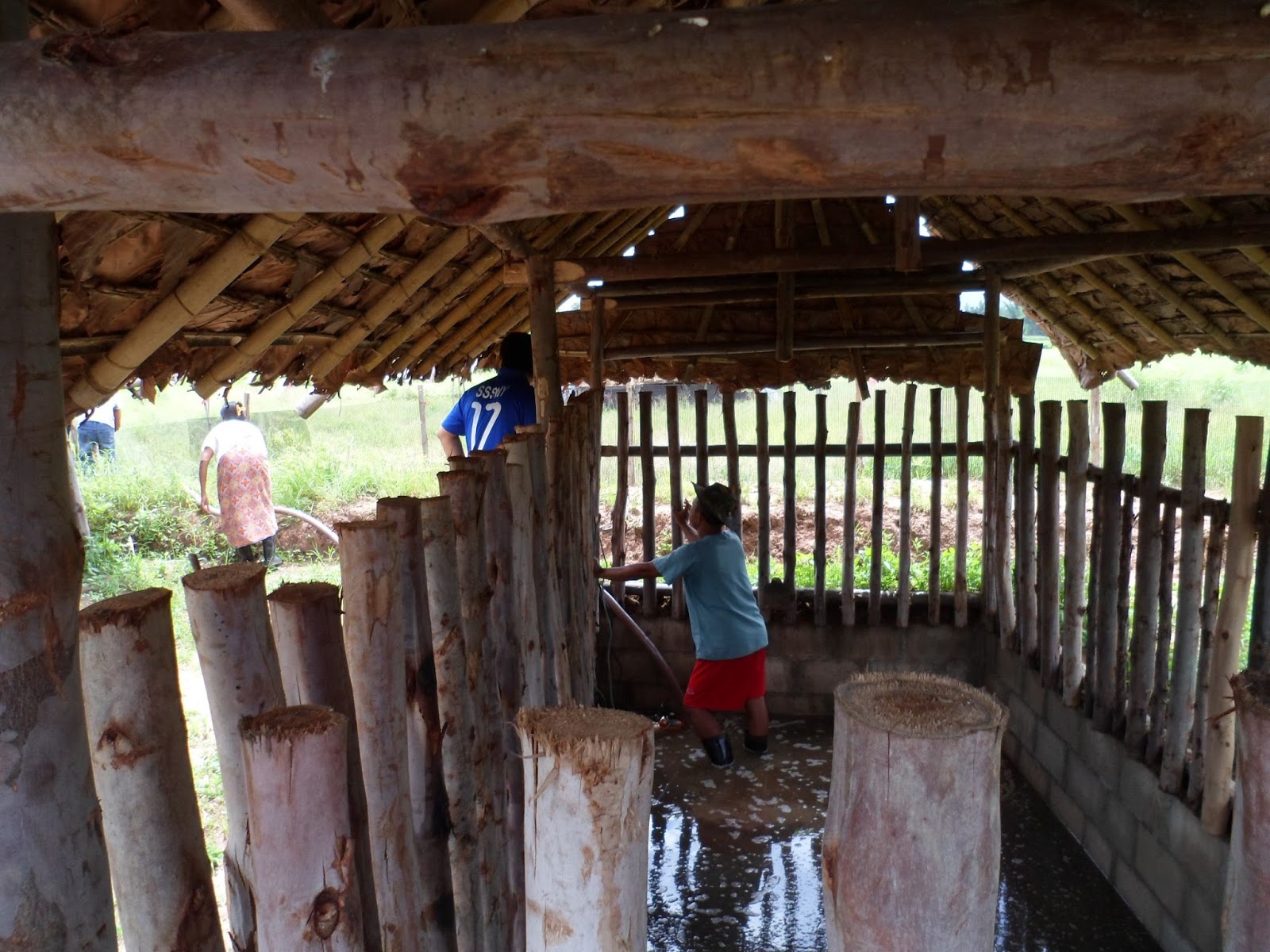
  • Last week we purchased a new water pump in order to drain flood water from the pigpens. Subsequently, we worked together to drain the remaining water in the pigpens employing the expertise of our carpenter/engineer friend, Mo Sas.  See efforts below.
  • Pigs were moved from the far end pen to the middle pen by Khom Loy Staff immediately after the pen was refilled with dry soil, rice husk, coconut husk and sprayed with EM fertilizer and salt according to the Korean-developed Natural Farming method that we follow.
  • To account for the damages from the flood, we hired workers to re-dig drainage ditches and provide new, dry soil for the second pigpen.  
  • We employed the skills of Mo Sas to add a new circuit breaker to our TPC storage house in order to increase the safety of our power source. 

Attaching a hose to our new water pump to drain out flood water from the pigpens.

U Tin Yu placing the water pump in pen 2.


Pen 3 damages before flood water was pumped out.


Our team with our new gear--the newly made biochar apparatus, water pump, and pig feeding troughs.

U Tin Yu and Sai Aung moving the pigs from one pen to another. 

Pigs enjoying their new dry pen!


Banana Chopper Up and Running at TPC
After we completed a replication of our the old banana chopper used for Hwe Kha Lohke School pig project FBS (fermented banana stalk)-making, we brought the new chopper to our land at TPC.  Until recently we did not have adequate time or labor to set it up.  With time approaching to start integrating FBS into the pig feeding schedule, we solicited the help of Mo Sas once again.
Last Friday, our team spent several hours putting together the foundation for our banana chopper.  Guidance and expertise from Mo Sas was integral in setting up the chopper correctly.  See our efforts below!  We plan to start making FBS next week with banana stalks supplied by a school partner.  Keep posted for future updates.  

Ko Lynn and Sai Aung moving the banana chopper.


UPLift members putting together the banana chopper base.


Financial Literacy Assessments have picked up again with Ko Lynn taking initiative to meet with various community groups (especially women's groups) in 3-4 potential communities to prepare our Financial Literacy Training Project in December-January.  So far we have been given some community assessment information from Wide Horizon students on a few of our potential community project partners and Ko Lynn has visited each of the communities at least once. One of the potential communities is located on the premise of a factory that processes and distributes bulk agricultural produce and develops fertilizers/pesticides for large scale farming.  Almost all of these Burmese migrant families (approximately 100 families) living on the premise were uprooted to Thailand in 2008 after Cyclone Nargis and as we have already noted in our assessments, the living conditions are squalid with minimal living resources and few opportunities for upward mobility. Some of the men are plagued by depression and drug/alcohol abuse. As we do not know much about the role of women yet, further assessments will allow us to determine if this community is the best fit for our upcoming Financial Literacy Project in 2014.  

We also continue our exploration of Phase Two Financial Literacy: Small Business Development at the Cattle Yard--planning meetings to brainstorm income generation prospectives for the women's group.   


School Garden Project Assessments
UPLift staff has begun school garden assessments to find 3-4 appropriate schools to partner with this dry/cool season for year 3 of our school garden projects.  As we complete the assessments, we look at such things like square footage of the school, flooding issues, water sources, school food budget, student activities, teacher involvement, past/current garden-related projects, number of students, ages, whether or not students live/board on the school premise, and  compatibility with the headmaster.  Thus far, we have looked at two schools--one of which (called Irawaddy Flower Garden) we assessed last year but did not have an opportunity to work together. We have made an initial visit to Irawaddy and next we will complete a more formal assessment along with a day-long mock garden training to help determine the students/ teachers willingness to do the larger project.  

The second school we've begin to assess is the professional training/community development school for older students called Wide Horizons--the same school we worked with on the Financial Literacy Project in the past and also where Ko Lynn received his training.  Though Wide Horizon is not traditionally the kind of school we work with, we can clearly see the benefit of doing a garden project there as they are a trusted project partner and have expressed great enthusiasm for the project.  The school setup, similar to TPC with students boarding/living at the school grounds throughout their entire matriculation, allows us to work with boarding student and teach them skills they can take with them when they complete their studies. As it is not our traditional school partner (we usually work with primary schools) the outcome of doing a project here will be a trickle-down effect since no doubt some of the Wide Horizon students will return to Burma and propagate all the skills they learned--including agricultural practices taught by UPLift. We look forward to moving ahead with Wide Horizons and assessing the project possibilities further.


That brings us up to speed for now. We'll be back with more updates soon!

Tuesday, August 6, 2013

July Project Updates


UPLIFT MONTHLY OUTCOMES REPORT— JULY 2013 PROGRESS

General Update: Floods in late-July affecting the areas in and around Mae Sot caused short-term delays to UPLift project activities such as planting sweet potatoes, beginning TPC students trainings on natural farming pig rearing, and the pig-slaughter test run. Beyond these delays, UPLift staff was also limited by travel restrictions due to the floods, which postponed visits to the TPC Land/coordination meetings with U Tin Yu for some days.  Despite these hurdles, the UPLift team was able to achieve considerable strives in July and look forward to continued progress in August. 

Flooding in town. Mae Sot July 30, 2013


Project-Specific Updates
Teacher Preparation Center (TPC) Projects
In January 2013, UPLift began planning for an agricultural training program at TPC, a teacher training college for young educators from Burma.  This project is being done in partnership with Global Neighbors (Canada), the Karen Teacher Working Group, TPC and World Education Thailand.

After acquiring around 4 rai of land, we have been developing this land to create a live farming site for Burmese teachers, migrant schoolchildren, and other groups to attend trainings.

Trainings are to include: natural farming pig rearing using sustainable low cost practices, school garden projects (maximizing minimal amounts of land to produce optimal produce yield), and sustainable household farming practices—to demonstrate the capability of a family to live sufficiently from this amount of land using several different farming techniques.


1. TPC Land:
·      Ajarn Prasongs Visit & Recommendations: On August 18, we received a visit from Thai-Karen Organic Farmer, Ajarn Prasong.  This visit was highly important in making educated and appropriate decisions about land planning at TPC.  Ajarn Prasong’s visit resulted in several recommendations and comments.  A summary of which are followed according to the subject area:
1.     Pigs: The pigs should be given two essential supplements/vaccines including Iron and a parasite vaccine; we should add 1kg of salt to the pigpen to aid in composting; male pigs should be castrated to ensure optimal growth; we might consider buying our own purebred sow in the future and hire males to breed with. 
2.     IMO’s: We can reuse the solid materials leftover from the previous IMO (Indigenous Micro-Organisms) batch mixed with sugar and water to make new IMO’s.  The process of fermentation will take longer about 3-4 weeks instead of one.
3.     TPC Land: Aj. Prasong's recommended strongly not to rush making use of all the land. The soil needs substantial remediation in order to be optimally fertile and this will take time—he guessed 5-10 years. Given a 2-year time frame with a plan to use all the land, he said it would be near impossible to improve the whole of 2.5 rai.  If we try to plant or do too much, we would be wasting our resources (his estimate for sufficient fertilization was 1 ton of fertilizer/year/rai!).  
Instead he suggested to stick with our sweet potato/ 3-sisters crops (and include crop rotation on these plots to keep the soil healthy) and also cultivate several small plots of soil for "everyday" crops such as chili, garlic, lemongrass, eggplant, basil & tomatoes--the vegetables/plants eaten by villagers often.  Incorporating "everyday" crops on our training plot will easily illustrate how a family can grow their own veggies & have a bit of surplus to sell with limited space.  In addition, he recommended an herb garden &/or using herbs as border crops in between small plots.   For lowland, he suggested to keep it simple: plant plenty of Morning Glory and/or leafy greens as cover crop, tend & till the soil with new fertilizer and allow it improve in time. On remaining plots, he offered that we plant robust bushes for pig food. 
 
Aj. Prasong (far right) discusses land planning with the Uplift Team.
Taking notes on Aj. Prasong's suggestions.
·      16-month plan for TPC Land
Upon deliberating and a lengthy planning process keeping in mind our goals, Aj. Prasong’s recommendations, the seasons and other Uplift projects, the team put together a cohesive 16-month (thru December 2014) plan for the land at TPC.  In addition, land was sectioned into 10 plots to make planting organization easier. This plan entails: Using plots 1-4 to plant “everyday” crops and use many different methods of gardening to illustrate small-scale garden options such as bamboo beds, raised mounds, rice sack/container gardening and vertical gardening.  Plot 5: Plant leafy bushes for pig food; Plot 6-7: Low maintenance planting green cover crops, tilling & aerating then repeating; Plot 8: Plant morning glory; Plot 9: Plant 3 sisters; Plot 10: Plant sweet potatoes and rotate with different varieties of beans.  This corresponds with the plot map seen below:


·      Biochar Making Plans—Khom Loy has contracted with a local carpenter, Mo Sas, to build two different types of biochar implements.  When we presented Mo Sas with pictures of the prototypes we wished to have, he was very positive and eager to help us.  He continues to build these implements at out Khom Loy Office during weekends.  We anticipate completion in 1-2 weeks depending on the weather. 
First Bio-Char Implement made to use the "rice husk hill" method--see below what it will look like...

·      Sweet potatoes: Along with the 16-month plan, Uplift staff put together a more detailed action plan for growing sweet potatoes.  This plan entails first cutting the grass, then tilling the soil, prepping the soil with rice husk and IMO fertilizer, finally planting and maintaining the plants by watering as needed, weeding, and controlling insects.  As of now, we are still in the initial steps of cutting the grass and tilling the soil.  Since it rained virtually non-stop during the last 7 days of July (we anticipate more rain in early August), U Tin Yu has had no chance to till the soil and prep it due to water saturation leading to the inability to aerate properly.  We continue to watch the weather and with some certainty can predict that sweet potatoes will be in the ground by end of August. However, if the rains continue as they have been, we may wait even longer for a drier period.  We already have a plant supplier through local Dominican Nuns. 
·      Bananas: Of the 116 bananas planted with help from TPC student in June, about 40 of these plants were uprooted due to miscommunication with workers digging the drain ditch/ water pipeline for Global Neighbors.  After 3 days of being out of the ground, Global Neighbors workers replanted the plants.  This disruption in the growing process has caused evident delays in the maturation of these 40 bananas.  Some of these plants are seemingly dead but we still have the majority of our plants in tact and growing nicely.
·      Research IMO’s—Gaining More Insight/Understanding:  U Tin Yu--our Field Manager Ag. Officer, brought up a valid point that we do not know enough about IMO’s in terms of what is in them exactly, why they are particularly beneficial and how can we back these claims as we teach students about IMO’s.  From these concerns stemmed a day devoted to researching scholarly articles and videos about IMO’s and making documents that would supplement our own knowledge and that of students in the future.  From this experience, we understand that we are still learners and there is far more information we have yet to discover even about the topics we spend a lot of time investing in. 
    Making weekly/monthly work plan for U Tin Yu: With the completion of a 16-month plan, we shared our map with U Tin Yu and discussed how these plans would play out in the months to come in terms of his work schedule.  Furthermore, we incorporated more detail by setting up weekly and monthly work goals and objectives for U Tin Yu.  Together with U Tin Yu we talked about these plans in great detail to ensure optimal understanding of what is expected of not only him but also every UPLift member.  To check the progress of weekly goals, we made plans to come to TPC every Monday and Friday to meet with U Tin Yu with the exception of extenuating circumstances like sickness or weather. 


2. TPC Natural Farming Pig Rearing Project:

·      Pigs Arrival:  By the 3rd week of July 2013, our long-awaited pig herd arrived at the TPC Land.  The 10 pigs, newly weaned from their mother, settled nicely into one of our 3 pigpens, which had been pre-filled with manure, rice husk, and IMO fertilizers.  Since arrival, the pigs have been under the care of U Tin Yu and his wife for regular feeding, watering and spraying IMO’s.  Feeding started out as estimated 7-10 kg of store feed for the first week along with green snacks and kitchen leftovers twice a day.  The first two weeks required a feeding adjustment, as the pigs did not eat as much as expected.  As of now, the pigs are growing nicely and have increased appetites even despite the rains. 
Pigs first arrival at TPC.

Staying out of the rain.
Refilling the pigpen after the rains.


·      Pigpen Flooding: Fortunately, the pigpen where the pigs are currently living was not affected by flooding—only minimally which we remedied quickly with extra bedding.  However, the other two pens did not fare as well.  The pen on the far end was affected the most with a huge amount of water retention and deterioration of the concrete walls.  To fix these issues, we require  purchasing a water pump to drain the current “flood” in the pens and ensure this will not happen again in the future. 
The pigpen on the far right was most affected by flooding.

·      Pig Feeding and Watering Systems: We are currently contracting the carpenter, Mo Sas to build a pig feeding trough since the current feeder is only temporary. As for watering, the local TPC carpenter offered his expertise to make us a watering canteen with two drip spouts for pig drinking water. 
·      NF Pig Training Planning: Beginning July 23, Uplift team members began officially training new members (U Tin Yu, Sai Aung) in the Natural Farming Pig Rearing Method.  This aim of this preparation training is to “train the trainer” and ensure everyone feels comfortable with the material. With restraints of flooding, UPLift members were only able to complete 4 days of training before delays set in.  The training will reconvene again the first week of August, weather permitting. 
·      NF Pig Trainings with TPC Students: Once UPLift staff is completely confident and competent in the training material, we will commence pig-rearing trainings with TPC students.  The first of 6 training rounds with TPC (students broken in to groups of 10-15 people) will take place towards the end of August, weather permitting according to the schedule agreed upon with UPLift Staff and TPC Headmaster, Sia Ehkhu. Other trainings such as that with SAW (Social Action for Women) will take place on a TBD date.
·      Pig Slaughter Test Run: Towards the end of July, we found a viable seller of a market-ready pig in order to conduct our slaughter test run and associated costs/profits.  However, given that we could not confirm with our potential meat buyer,  we had to postpone the pig slaughter test run until August.  If we do not receive confirmation from our buyer by the first week of August, we will seek other potential buyers such as one of the many nearby migrant schools.  Coolers still need to be purchased in order to transport raw meat from the slaughterhouse to the buyers.

3. School Garden Projects:

Funded by Thai Children’s Trust (UK), the school garden program provides schools with sound techniques and knowledge for setting up and maintaining their own nutritious gardens, thus giving schools their own valuables sources of nutrition.


·      Garden Training with TPC students: On Friday, July 12 2013, team UPLift delivered basic garden maintenance training to the 81 students currently studying at Teacher Preparation Collage (TPC). Presentation sections were allocated amongst member in such a way that each UPLift member was responsible for delivering certain objectives.  In addition, U Tin Yu—our on-site Agriculture Officer—lent antidotes of his experience as a farmer in Burma and candid answer to critical questions asked by audience members—after each of his responses he received a round of applause for his input.  His contribution was certainly appreciated during the training as it enriched the content of our delivery.  
The training included basic knowledge of ecosystems and agriculture, soil management, natural farming (use of IMO’s without chemical fertilizers) versus chemical fertilizer farming and the bamboo/ mound method of small scale optimized output gardening.  Once the theory part of training concluded, we proceeded to the TPC Garden plots and together with the 81 students, set up 6 bamboo beds and filled them in using natural materials such as rice husk, dry compost, green compost, and black top soil.  Many hands made for light work as the process took barely an hour to complete start to finish. After this stage, we left the responsibility of garden care to the TPC students—broken into 6 groups each responsible for 1 bed and 1 mound in the future. 
Boots, gloves, hoes and knives for TPC students to use are located in the shed where we store IMO’s, the banana chopper and various materials.  We developed a process of checking-in and checking-out tools with U Tin Yu and Teacher A Bing in order to mitigate the loss of tools.  This also heightens the sense of responsibility on the part of students.  U Tin Yu keeps a sign-in log in the storage shed.
Garden theory training with UPLift Staff.
U Tin Yu discussing the difference between organic and chemical fertilizer.
Uplift staff helping out.
TPC students putting theory into practice making new bamboo beds.
TPC students working together to install new garden beds.

·      New Agriculture Officer: In July, we welcome another new staff member, Sai Aung Tun.  Sai Aung originally teamed with Khom Loy as a translator for the Early Childhood research project (UBS) in May.  He joins us after working as a translator for the organization Migrant Education.  He will primarily assist with agriculture-related projects such as the school garden projects, trainings at the TPC land/Natural Farming Pig Rearing, agricultural skills development, and lastly, he will help our Montessori team with additional translating when required. We welcome him to Khom Loy and look forward to continuing to work with him!
Sai Aung on the left learning about school garden projects.


·      Potential Garden Project at Wide Horizons: One of the current community development teachers at Wide Horizons vocational school contacted Khom Loy about collaborating on the school garden project. This teacher and the students are very keen on doing the garden project. We have not confirmed whether or not this is possible because Wide Horizons students are ages 19-30 years old and these ages generally falls outside of the normal primary school criteria for garden projects. 

4. Financial Literacy Project Planning:

This project, given seed funding by UN Women and Mastercard Foundation in 2011, aims to develop core financial skills for Burmese migrant women in the Thai-Myanmar border.  After an initial round in 2012 at a landfill community, this year we have been working in a community living and working on a cattle yard in Mae Sot, Thailand.
The project has two phases: delivering financial literacy training for women, followed by the research and development of small business opportunities.  In 2013, we successfully delivered training to 40 women and 4 men, mostly of Karen and Burmese Muslim ethnicities.  After finishing the first part of the program, we now continue to develop phase two of the project.


Cattle Yard: Due to weather and various project situations, Financial Literacy Project was not able to move to the second phase of the project at Cattle Yard this month. As we mentioned in earlier reporting, we would like to help the women from Cattle Yard community by setting up Rotating Savings and Credit Association (RSCA). We are researching the methods that are best suited for the community and we still continuing to develop a plan for implementing the second part of the project at the Cattle Yard.

UPLift team member, Ko Lynn following-up with a financial literacy trainee at the Cattle Yard. 

Community Assessments: Additionally, we plan to visit different communities in Mae Sot for our 3rd round of Financial Literacy training. Our project partner Wide Horizons school has done several community needs assessments in the Mae Sot areas. We also have some community profiles from last year, which we will revisit. Together with Wide Horizons, we will compare data to assess the different communities in Mae Sot and determine the best fit for the financial literacy project.

5. Early Childhood Research Team (UBS) Conclusion:
Between May and June 2013, Khom Loy hired 3 researcher and 2 interpreters to  conduct baseline early childhood research to develop understanding and be able to improve educational programs in the future.  The results of which are as follow...

After concluding on July 5, data for the comparative early childhood education was digitized and coagulated.  Researchers made extensive concluding notes and inferences from the experiences of collecting data on over 60 students at Ta-ad and Hua Fai Primary Schools which amounted to over 900 pages of raw data.  Planning for next year’s follow-up research is already underway given what was learned from this year’s pilot.  


Stay tuned for more updates and a formal introduction to our newest staff, Sai Aung Tun!